|
Isometric exercises, often called the forgotten and least “sexy” muscle contraction, are a powerful but frequently overlooked tool that every clinician or trainer should include in their toolbox. I get it—exercises involving non-moving joints might feel counterintuitive. After all, our bodies are designed to move through space. However, research demonstrates that isometrics positively influence dynamic strength, jump performance, running, cycling, sports-specific soccer skills, Muay Thai striking, climbers’ finger flexor grip strength (yes, this is a measurable thing), tendon properties, and even pain relief!
With a pretty extensive list of positives it would be neglectful of all of us in medicine and fitness to not have a better understanding of how we can specifically use isometrics for our everyday clients.
Isometrics- The Basics
Isometric exercise is a type of resistance training that produces force without external movement. It’s also a valuable tool for training muscles and joint angles that might be problematic—painful or poorly controlled—when moving dynamically. This makes isometrics especially useful for individuals who lack the strength or motor control for dynamic movements.
Isometric exercises have been shown to demand less energy while improving joint angle-specific force production. Some might argue, “Of course, doing an isometric makes you stronger at isometric movements” (cue facepalm emoji), but evidence also shows a correlation between isometric strength and improved dynamic movement capabilities. This includes maximum force development during sports and dynamic exercises.
Meaning that yes, not “moving” can actually make you better and stronger at moving.
Isometrics can even surpass dynamic strength training in increasing angle-specific strength, particularly at joint angles where individuals face the largest biomechanical disadvantages. While the applications of isometrics are vast, I like to keep it simple by categorizing them into two primary uses.
Isos for PAIN and Isos for POWER.
Isos For Pain
Research consistently supports using longer (30–45 second) isometric holds during warm-ups to significantly decrease pain (often by more than 50%) in individuals with tendinopathies.
The key here is to focus on lengthened muscle positions, typically at joint angles of 60–100 degrees. These isometric holds help reduce cortical inhibition and increase maximal voluntary contraction (MVC). In simpler terms, they improve a muscle’s ability to activate, even in the presence of pain.
The total time under tension is more critical than the specific exercise, with evidence supporting 5 sets of 30–45 seconds. A good rule to follow is to match rest time to work time (e.g., 30-second hold, 30-second rest).
The Heel Elevated Spanish Squat Iso
This is my favorite exercise for managing chronic and acute knee pain. The banding forces anterior knee deceleration (knee bending) while the heel wedge encourages an upright trunk position. Together, they create a quad-dominant setup that’s nearly impossible to cheat.
Slant Board Split Squat Iso
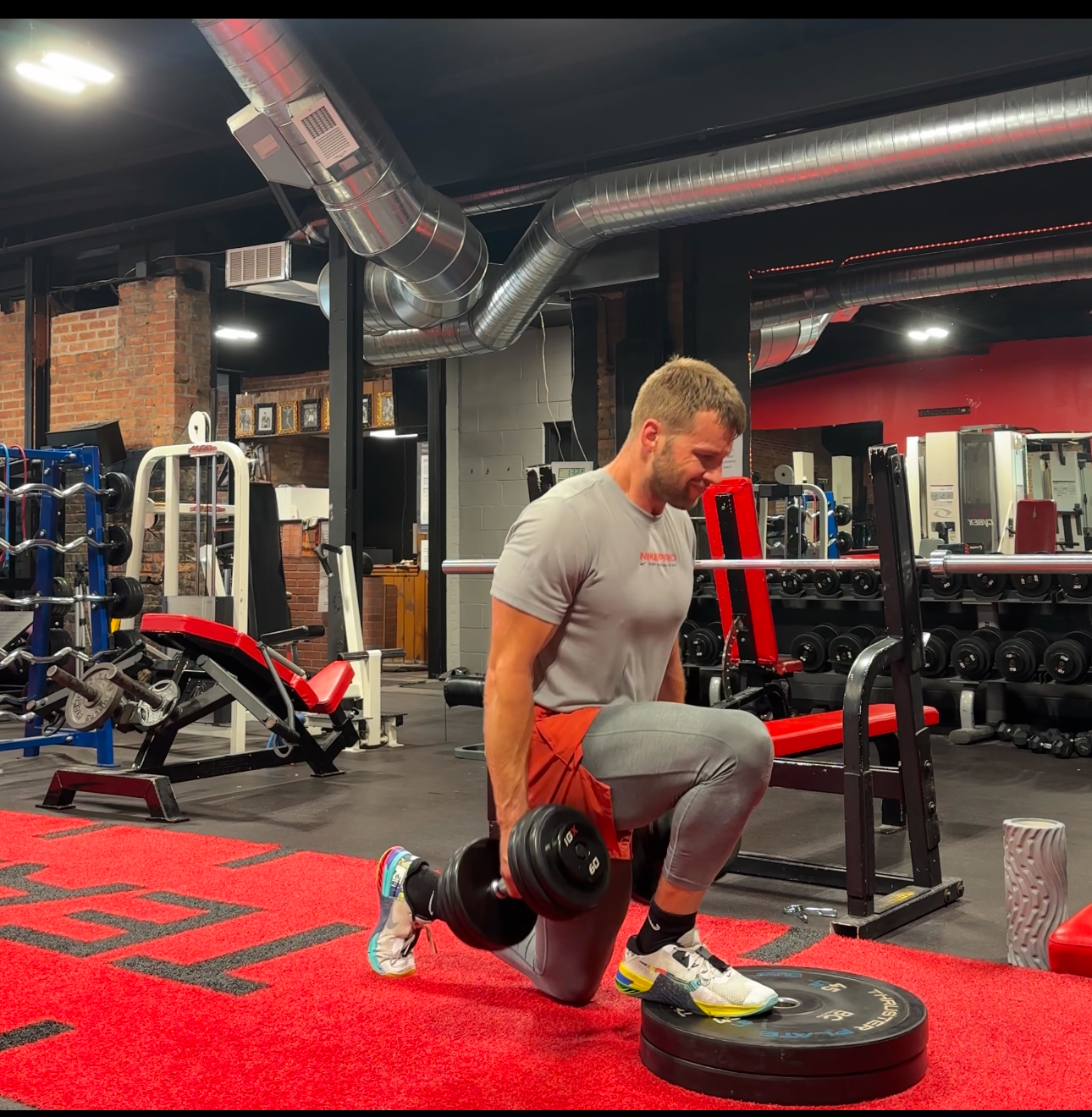
Similar to the Spanish squat in application, this exercise introduces a unilateral bias. The slant board promotes a “knee-over-toe” position, pre-lengthening the quads and demanding higher muscle activation. I recommend starting from the bottom position to maintain better control.
Seated Leg Extension ISO
I really like machines as one of the best ways to have high levels of mechanical tension with minimal to no stability requirement (i.e. we are not needing to control gravity). What this does is essentially allow you to work HARDER without having to manage your technique. This is especially useful for people who have knee pain during any squatting or lunging and we have an added benefit of being able to target SPECIFIC joint angles as well as the amount of muscle contraction based on pain.
For this, put the weight stack all the way up and essentially “kick” into the leg pad. You can then simply alter the knee angle and the effort level based on the presence (or absence) of knee pain
Hamstring Foam Roll ISO
The hardest ISO you’ve never done, the hamstring foal roll iso is an extremely challenging exercise for the calf and hamstring musculature. Set the ball of the foot on the foam roll to mimic more “athletic” positioning and then drive through the foot to maintain a high hip and calf raise position. If it’s too hard, bend the knee more to get the hamstring in a less lengthened position and vice-versa- get the knee straighter to make it harder. I have had more than once instance where this exact set up results in a near-immediate hamstring cramp so trust me when I say- start slowly!
Isos For Priming
Isometrics are also effective for priming the central nervous system (CNS) by leveraging post-activation potentiation (PAP). In simple terms, performing a high-effort isometric primes your brain to recruit more muscle fibers for subsequent dynamic exercises. This priming effect lasts about 5–9 minutes, so your hardest lifts should immediately follow.
To maximize priming, use “overcoming” isometrics, which focus on maintaining near-maximal effort (90–100%) for 5–7 seconds. Perform 3–5 sets to strike a balance between activation and avoiding fatigue.’
That’s it.
Simple and effective.
Push Up Medball Iso
For this set up, grab any med ball (preferably, one that is not too squishy) and start activating the pecs by pushing the ball together FIRST. Once you achieve this, slowly lower your body down until the elbows are around 90 degrees and then just squeeze the ball as hard as possible for 5-7 seconds.
Squat Rack Push ISO
This iso does not need to be a squat rack. It can be ANY immoveable object (like a wall). The key is to achieve a 90 degree shoulder and elbow angle which is where you will be the strongest and best able to give a high output. Get in position and PUSH!
Squat Rack Single Arm Pull ISO
Same as above, you can use any immoveable object here. Get into position, elbow around 90 degrees and now PULL as hard as you humanly can for 5-7 seconds.
Banded Pull Iso
For this set up you will need the heaviest band you have (i.e. one that you cannot do a single arm row with). Pull it to your chest with 2 arms, keep it there as you step back to get max tension then let go with one arm. Now you are in a single arm pull position that you COULDN’T get into just with one arm. Keep that elbow right at 90 for a max back burn!
Split Squat MB ISO
A great single leg priming pattern OR even a single leg exercise for someone who is unable to jump/move dynamically due to pain. Grab a light med ball (6-8lbs) and give it a HUGE squeeze. Then slowly lower down to 90 of the knee and hip while using the tension from the upper body squeeze to “turn on” the lower body. A nice cue here is to think about pulling the back knee and front heel closer together as a way to kick on even more tension.
ISO To Dynamic
Although technically not just an isolated ISO here, using a pre-set iso is an excellent option to prime the brain directly before moving into the dynamic component of the movement. For example (as see in the video) using a 10 second pre-priming iso to increase motor unit recruitment and then immediately move right into the dynamic pattern under load. This can apply to literally ANY exercise in the gym we just want to make sure the loads and set ups make sense.
Strap ISO squat/deadlift
The set up here is the perfect “tweener” between a pure squat and a pure hinge that really allows it to be applied across the spectrum to BOTH movement patterns. The key here is to make sure the strap you are standing on DOES NOT STRETCH. So think, a yoga stretch out strap, a towel or even the straps on a suspension trainer. Grip it and rip it!
Pro-Tip: the only people I NEVER use this with are those with a recent low back posterior disc herniation as this set up mimics almost exactly how those injuries occur- flexed spine with a heavy Valsalva.
Isometrics: The Power Of Stillness
Isometrics might be the “forgotten muscle contraction,” but their impact is anything but forgettable. From reducing pain to enhancing power, these static holds are a dynamic addition to any fitness or rehab toolbox. By embracing the power of stillness, you can unlock new levels of control, strength, and performance—whether you’re managing pain or priming for peak output.
|